Research perspective · 01
Closing the loop in
precision oncology
From cell states to treatment hypotheses: how virtual cells could connect prediction, experiment, and patient evidence.
ProteinTalks uses drug-induced protein changes over time to predict treatment effects and prioritize candidates for patient-derived organoids.1 What caught my attention was the connection: measurements of how cells change become a starting point for deciding how to intervene.
I see the cycle below as a useful direction for precision oncology. Each step should produce something the next step can test, and the result should influence the next round of data collection.
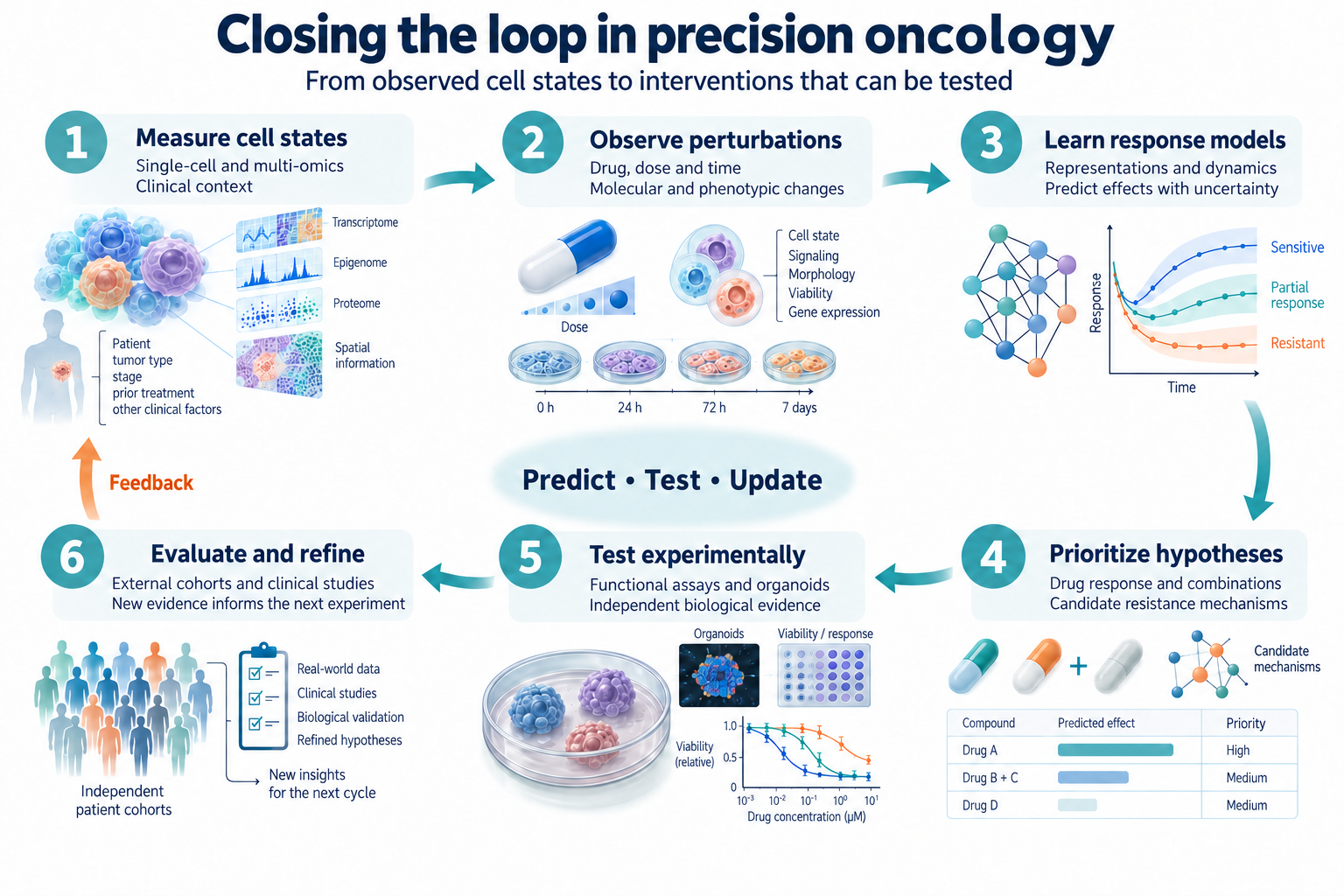
Steps 1 and 2: Learn what changes, not only what is there
Cell atlases describe the states we can observe. Perturbation experiments help reveal which states a treatment can produce. A virtual cell needs both kinds of evidence.2
Consider cells that survive a drug. Did they barely respond, or did they respond and then recover? The endpoint can look similar, yet the intervention we would try next could differ. This is why I would prioritize matched measurements before and after treatment, with time and dose preserved. For single-cell research, adding another million cells is most useful when they fill a missing biological context or response, rather than repeat what is already well sampled.
Steps 3 and 4: Turn a predicted response into a treatment hypothesis
The model should connect the starting state and treatment to molecular changes and an eventual phenotype. That gives us something more specific to investigate than a sensitivity score.
Suppose it predicts an early response followed by activation of a candidate escape pathway. The next hypothesis is concrete: would blocking that pathway prevent recovery? A drug combination now has a biological rationale to test. The pathway prediction is a lead, and targeted experiments determine whether it explains survival.
This is where virtual-cell models could help narrow the search for mechanisms and interventions, as Bunne and colleagues propose.3 I would prioritize hypotheses that are both experimentally accessible and informative about why a treatment succeeds or fails.
Steps 5 and 6: Make validation feed the next round
Functional assays can test the proposed dependency; organoids can test drug effects in patient-derived material. Patient cohorts then ask whether the signal remains relevant alongside clinical variation. Evidence from these settings answers different questions; clinical benefit would need prospective testing.
The feedback arrow matters when a disagreement changes the next experiment. If recovery occurs sooner than predicted, sample earlier. If a small population survives, resolve that population. Qian and colleagues describe this principle as closed-loop learning: predictions help direct new experiments toward gaps in the model’s knowledge.2 Successful results and failed predictions both belong in the next round.
Where this could lead
A virtual cell offers a way to explore possible responses. A patient-specific digital twin would also need to update as new observations arrive during treatment.4 Moving from a pretreatment prediction to a model that follows an evolving tumour is the development I find most compelling.
References
- Sun, R. et al. An operational perturbation proteomics-based virtual cell model. Nature (2026).
- Qian, L., Dong, Z. & Guo, T. Grow AI virtual cells: three data pillars and closed-loop learning. Cell Research 35, 319–321 (2025).
- Bunne, C. et al. How to build the virtual cell with artificial intelligence: Priorities and opportunities. Cell 187, 7045–7063 (2024).
- Asghar, U. S. & Chung, C. Application of digital twins for personalized oncology. Nature Reviews Cancer 25, 823–825 (2025).