Research Highlight · ESMO Open
Era-specific prognostic factors and an interpretable machine-learning survival model for RCC brain metastases
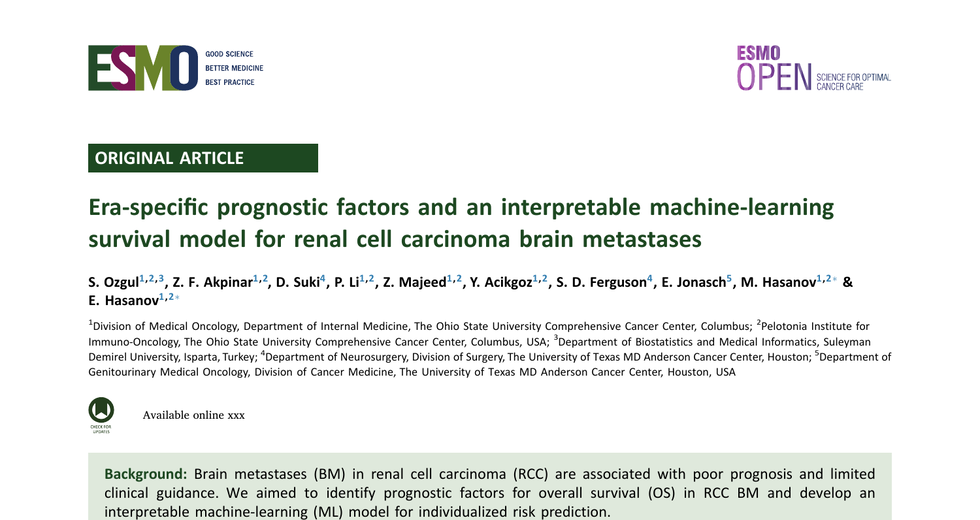
Published in ESMO Open, this study analyzes the largest reported cohort of renal cell carcinoma brain metastases treated with stereotactic radiosurgery or surgical resection and develops an interpretable, individualized survival prediction model.
Overview
Brain metastases from renal cell carcinoma are associated with poor outcomes and difficult treatment decisions. This work asks how prognosis has changed across systemic-therapy eras and whether routinely available pre-intervention information can support more individualized survival prediction.
The study combines era-specific clinical analysis with a rigorous machine-learning survival-modeling framework. The goal is not merely to produce a risk score, but to identify clinically interpretable prognostic patterns that can support future risk stratification and treatment discussions.
Clinical Context
Patients with renal cell carcinoma brain metastases are often managed with local therapies such as stereotactic radiosurgery or surgical resection alongside systemic treatment. Yet prospective trials frequently exclude patients with active brain metastases, leaving limited evidence to guide individualized prognosis in this setting.
Traditional prognostic tools such as IMDC were developed for metastatic renal cell carcinoma broadly, rather than specifically for patients undergoing brain-directed intervention. This creates a need for contemporary, disease-specific tools that reflect the changing treatment landscape.
Cohort and Treatment Eras
The retrospective cohort included 929 patients with clear-cell renal cell carcinoma brain metastases treated at MD Anderson Cancer Center between 1993 and 2021. Patients were categorized according to the predominant systemic-treatment era: interferon, tyrosine kinase inhibitor, and immune checkpoint inhibitor.
Overall survival improved over time, with median survival increasing from 0.8 years in the interferon era to 1.1 years in the tyrosine kinase inhibitor era and 2.0 years in the immune checkpoint inhibitor era. This temporal pattern provides important context for modern prognostic modeling: clinical risk factors should be interpreted within the treatment era in which patients receive care.
Modeling Framework
The machine-learning analysis used only information available before the first brain-directed intervention, enabling pre-intervention risk estimation. Multiple approaches were evaluated, including CoxNet, gradient-boosted survival models, random survival forests, survival trees, support vector machines, and ensemble strategies.
Model selection and tuning were performed with nested cross-validation, followed by evaluation in an event-stratified holdout test cohort. Performance was assessed using concordance, time-dependent AUC, Brier score, calibration metrics, and related survival-model evaluation measures.
What We Found
The final CoxNet survival model achieved a C-index of 0.64 and a 6-month AUC of 0.75 in the test cohort. These results suggest that a focused set of pre-intervention clinical variables can provide meaningful individualized risk information in a highly heterogeneous population.
The study also identified era-specific prognostic patterns through survival analyses and an immune checkpoint inhibitor-era prognostic classification tree. Together, these results show that clinical interpretation should account for both patient-level features and the broader evolution of renal cell carcinoma treatment.
Interpretability
For clinical machine learning, transparent model behavior is as important as predictive performance. SHAP analysis was used to examine feature contributions and identify the drivers of model predictions at both the cohort and individual-patient level.
Extracranial disease status and age at brain-metastasis intervention were the dominant predictors, with additional contributions from functional status and intracranial disease burden. This interpretability layer makes the model easier to audit and helps connect statistical predictions to recognizable clinical features.
Clinical Translation
An interactive web-based calculator was developed from the final model to make individualized survival estimation more accessible. The calculator is a research tool rather than a replacement for clinical judgment, but it creates a practical bridge from retrospective modeling to prospective validation and future clinical use.
More broadly, the project illustrates how interpretable machine learning can be integrated with clinically grounded survival analysis in precision oncology: the model is evaluated carefully, its limits are stated, and its predictions can be inspected rather than treated as opaque outputs.
Key Takeaways
- The study analyzes 929 patients with renal cell carcinoma brain metastases treated across three systemic-therapy eras.
- Median overall survival increased substantially in the immune checkpoint inhibitor era.
- The final CoxNet model achieved a C-index of 0.64 and a 6-month AUC of 0.75 in the test cohort.
- SHAP analysis highlighted extracranial disease status, age, functional status, and intracranial disease burden as important predictors.
- The work includes an interactive calculator to support future validation and translational use.