Research Highlight · JCO / ASCO Conference Abstract 2026
Transcriptomic signatures for treatment outcome prediction in renal cell carcinoma
A short walk-through of this ASCO 2026 poster is available as a video presentation, with the full poster PDF available online.
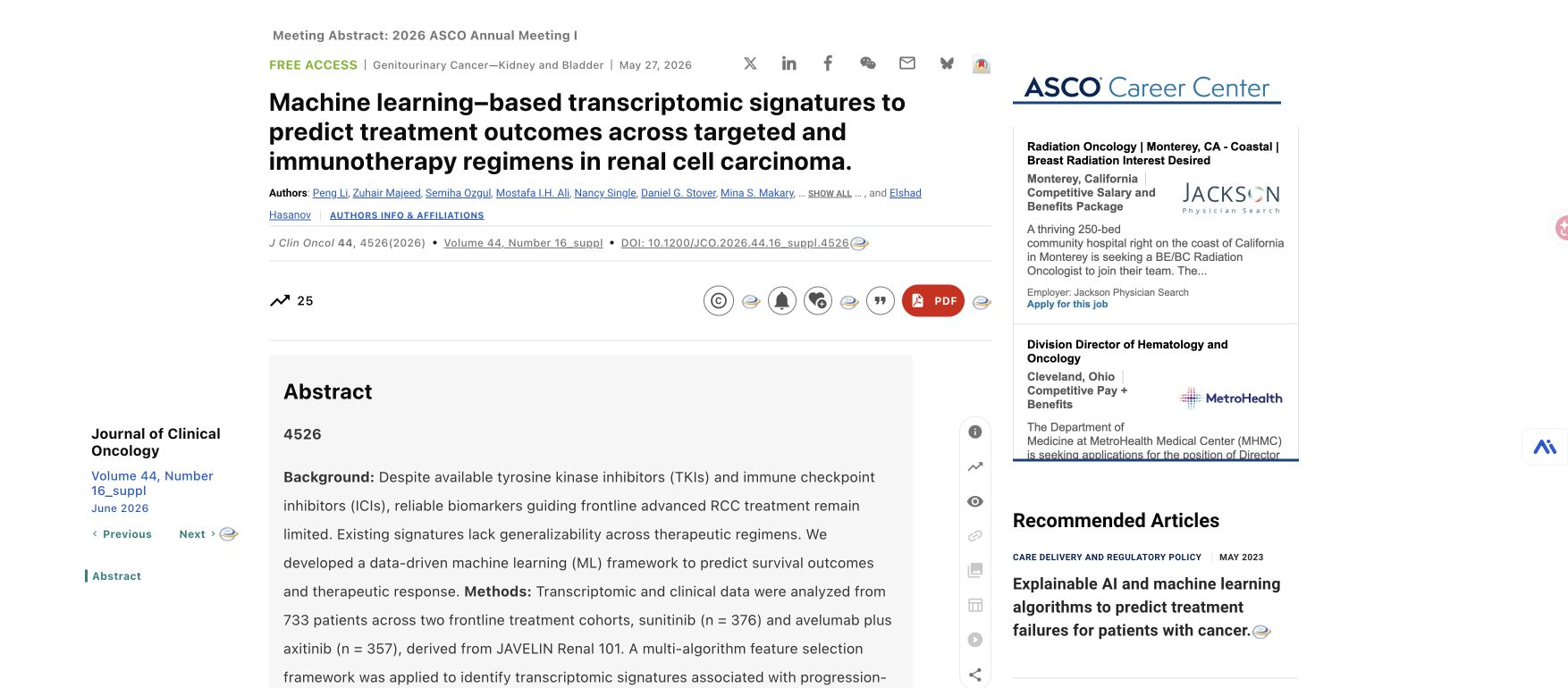
Overview
This project asks whether machine learning-based transcriptomic signatures can help predict treatment outcomes across targeted therapy and immunotherapy regimens in renal cell carcinoma. The work was selected for poster presentation at the ASCO 2026 Annual Meeting and published as Abstract 4526 in the Journal of Clinical Oncology ASCO Annual Meeting supplement.
The broader motivation is translational: renal cell carcinoma has multiple frontline systemic treatment options, but patients can show very different response and disease-control patterns. Transcriptomic profiles may provide an additional layer of tumor biology that is not fully captured by routine clinical variables or conventional risk groups alone.
In this project, the core question is not simply whether RNA expression can predict outcomes in one dataset. The more useful question is whether transcriptomic signatures can provide regimen-specific prognostic information across clinically relevant treatment settings.
Clinical Motivation
For advanced renal cell carcinoma, tyrosine kinase inhibitors and immune checkpoint inhibitor-based regimens have changed the treatment landscape. However, durable benefit still occurs only in a subset of patients, and clinical risk models do not fully explain why patients respond differently to different regimens.
The IMDC model remains clinically useful, but it was not designed to capture tumor transcriptomic states or treatment-specific molecular response patterns. That creates a gap between clinical risk stratification and molecularly informed treatment prediction.
Rather than treating machine learning as a black box, this work focuses on transcriptomic signatures that can be inspected, benchmarked, and related back to biological programs. That makes the analysis more useful for translational oncology, where interpretability and external validation matter as much as raw prediction.
Study Design
The analysis used RNA expression and clinical data from JAVELIN Renal 101 in two frontline treatment cohorts: sunitinib and avelumab plus axitinib. This design made it possible to evaluate transcriptomic signatures across a targeted therapy setting and an immune checkpoint inhibitor plus anti-angiogenic therapy setting.
The study evaluated progression-free survival, overall survival, and disease control. A central goal was to determine whether transcriptome-derived signatures could stratify outcomes beyond IMDC risk grouping and whether those signatures generalized across outcome definitions and treatment cohorts.
The project also included external validation and benchmarking against IMDC and published RCC transcriptomic signatures, which is important because single-cohort transcriptomic models can easily look promising without being clinically robust.
Modeling Strategy
The modeling framework started with transcriptome-wide screening to identify signatures associated with PFS and OS. These signatures were then used to derive model-based risk groups and evaluate whether high- and low-risk groups showed different survival trajectories.
In addition to survival stratification, PFS-derived transcriptomic classifiers were evaluated for disease control prediction. This connects the survival modeling task with a clinically intuitive endpoint: whether a patient achieves disease control versus progressive disease.
Because transcriptomic models can be difficult to interpret, the poster emphasizes signature-level summaries, Kaplan-Meier stratification, ROC and precision-recall evaluation, and benchmarking rather than only reporting a single aggregate performance number. This keeps the result closer to a usable biological hypothesis than a single opaque model score.
What the Signatures Capture
The signatures are intended to summarize expression patterns associated with treatment response and disease control. In this setting, that means looking for molecular signals that may reflect tumor biology, immune context, angiogenesis-related biology, and treatment-specific outcome differences.
The practical value is not simply that a model can output a risk score. The more interesting question is whether transcriptomic programs can reveal structure that helps explain why some patients benefit more from a given regimen than others.
One key interpretation from the poster is that transcriptomic risk scores showed stronger PFS/OS separation than IMDC risk groups. Adding IMDC to RNA-based models provided minimal additional improvement, suggesting that the transcriptomic signal captured prognostic information not well summarized by clinical risk grouping alone.
Benchmarking
Benchmarking was included to test whether the machine learning-derived signatures improved on common alternatives. The poster compared RNA-only models, RNA plus IMDC models, and IMDC-only models across both treatment cohorts. It also compared the derived transcriptomic signatures with published RCC transcriptomic signatures.
Across the poster analyses, ML-derived transcriptomic signatures achieved the strongest concordance-index performance for PFS and OS in both treatment cohorts. PFS-derived classifiers also predicted disease control in both the sunitinib and avelumab plus axitinib settings.
This benchmarking step is important for the scientific story. It moves the work beyond “we trained a model” and toward a more useful claim: regimen-specific transcriptomic signatures may provide prognostic value beyond established clinical risk models and previously published expression signatures.
Key Takeaways
- The study highlights transcriptomic signatures as a potential tool for treatment outcome prediction in renal cell carcinoma.
- The analysis used JAVELIN Renal 101 RNA and clinical data across sunitinib and avelumab plus axitinib cohorts.
- Transcriptomic risk scores showed stronger PFS/OS separation than IMDC risk groups in the poster analyses.
- PFS-derived transcriptomic classifiers predicted disease control across both treatment cohorts.
- The work was presented at ASCO 2026, published in the Journal of Clinical Oncology Annual Meeting supplement, and later featured by OncoDaily.
Resources
ASCO Abstract · JCO DOI · Poster PDF · Video presentation · OncoDaily feature